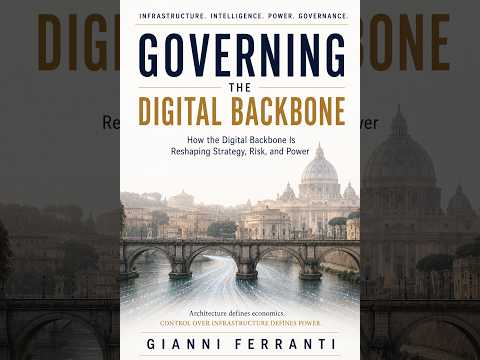
Author message
A message from the Author
Gianni Ferranti reflects on how digital infrastructure has become the foundation of modern business and society, and how executives and boards can build resilient, trustworthy, and strategically governed digital systems for the future.
Overview
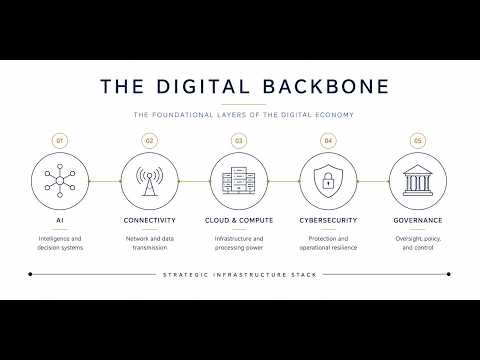
Overview — Governing the Digital Backbone
The transition of technology from a simple business tool to a vital strategic infrastructure: an integrated stack of AI, cloud computing, and connectivity now functioning as the primary operating system of the modern economy.

Board briefing
The Digital Literacy Gap
AI, cybersecurity, cloud dependence, digital transformation: boards discuss these topics more than ever, yet across Europe only a minority of board members have any technology experience. Why boards must govern technology like financial capital.
Governance
Power without Governance is Risk without Limits
AI, 5G, cloud, and cybersecurity are no longer separate domains. They are converging into a digital backbone that reshapes how decisions are made, how economies function, and how power is exercised — while governance fails to keep up.

Compute economics
The Rise of Agentic AI and Compute Scarcity
As Agentic AI scales, compute becomes a strategic input: cost-sensitive, capacity-dependent, and business-critical. With rising geopolitical tensions and unprecedented demand from global AI providers, the risk of chip and compute shortages is high.

Strategic briefing
Digital Trust — A Strategic Briefing
Why do we keep buying digitally — from platforms, banks, or public services we never physically meet? It's rarely just about price or features. It's about trust. Digital trust has become a competitive advantage.

Operating model
Simplicity — The Key to Sustainable Agility
Over the past decade, many organisations have embraced Agile to move faster and reduce friction between IT and business. Agile reduces friction — but it does not automatically reduce complexity. Without simplicity, local autonomy can unintentionally increase structural complexity.

Innovation cycles
Beyond the Metaverse
The metaverse may have cooled, but immersive technologies have not disappeared. The real story is not whether AR and VR are "dead" — it is what they reveal about innovation cycles. Spectacle fades. Infrastructure remains.
 Short
Reflection
Apology of a Connected Light Pole
Walking through any city, you've probably passed dozens of streetlight poles without noticing them. How large cities are reinterpreting streetlights as multi-purpose platforms — and the deeper question: which assets in your organisation are you still looking at too narrowly?